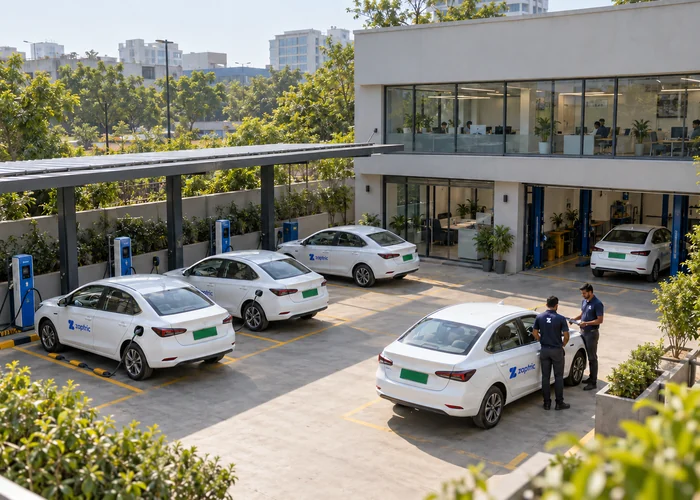
A missed driver shift, insufficient charge, unavailable demand and workshop downtime need different responses. Record the vehicle state and the reason for the lost shift. Avoid counting overlapping causes as separate full idle days when they refer to the same period.
Distinguish a ready vehicle without work from a vehicle that cannot operate.
Record when the interruption started and when the vehicle returned.
Assign an owner to the action required for the next shift.
02 /
Calculate the lease-only cost transparently
An illustrative daily lease allocation is monthly lease divided by 30. Multiply that figure by idle days and the number of affected vehicles. For example, a hypothetical ₹30,000 monthly lease and three idle days gives ₹3,000 per vehicle, or ₹15,000 across five vehicles. These figures are an example, not Zaptric prices or a prediction of earnings.
Use your actual lease cost and a stated day-count convention.
Exclude lost revenue from this lease-only calculation.
List other continuing costs separately rather than hiding them in the result.
03 /
Use the result to recover operating capacity
Review causes alongside the lease allocation to decide which operational issue to address first. A saving is only established when a change reduces a real expense or improves measured operating results. Use the calculator to compare assumptions, then check them against the fleet’s records.
Set the next action and a review time for each idle vehicle.
Measure the affected shifts after the change.
Keep cost allocation, avoided cost and extra revenue separate.